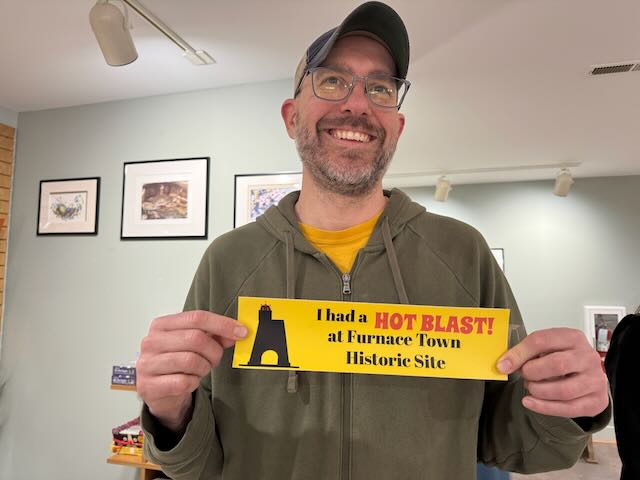
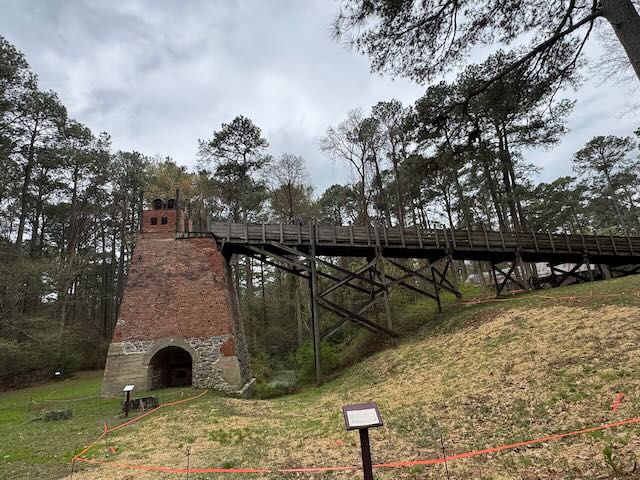
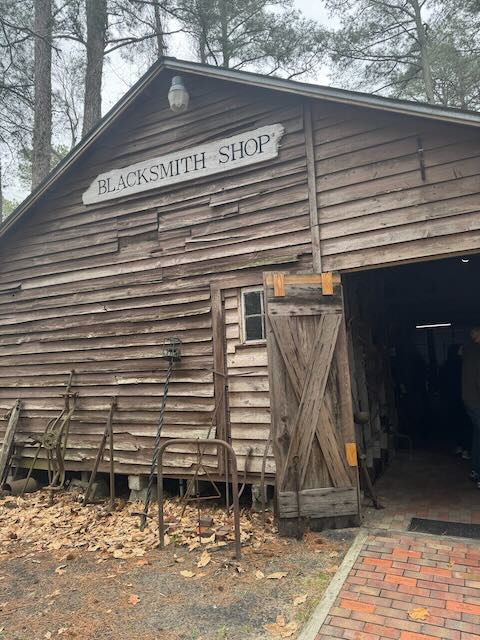
Furnace Town did not actually deliver the promised haunting. No spectres rattled the RV in the wee hours of the morning; the icy cold hand of a woman in white didn’t tap us on the shoulder. Nevertheless, the historical site gave us a unique glimpse (that we never knew we needed) into Maryland’s iron industry. For you New England friends, it’s like Sturbridge Village if all the “villagers” had suddenly disappeared and left you to piece together the history you were seeing. Besides the young woman who sold us our entry passes, we did not see another soul during our self-guided tour. What is currently standing at the Furnace Town site is a compilation of buildings from a similar era, collected from the surrounding areas of Maryland, to recreate the feeling of life as it was during the height of production (1828-1850).
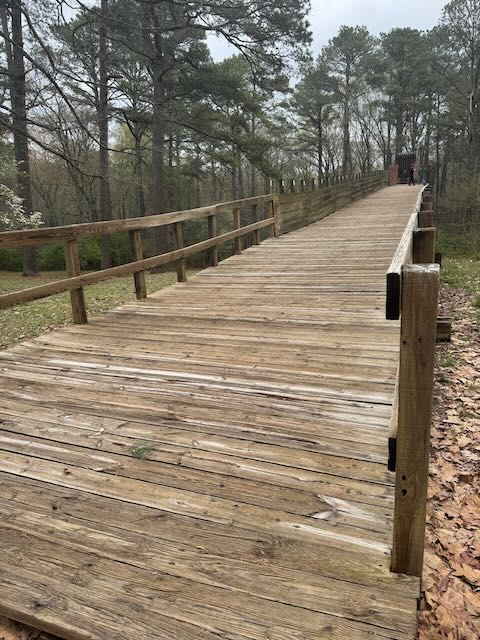
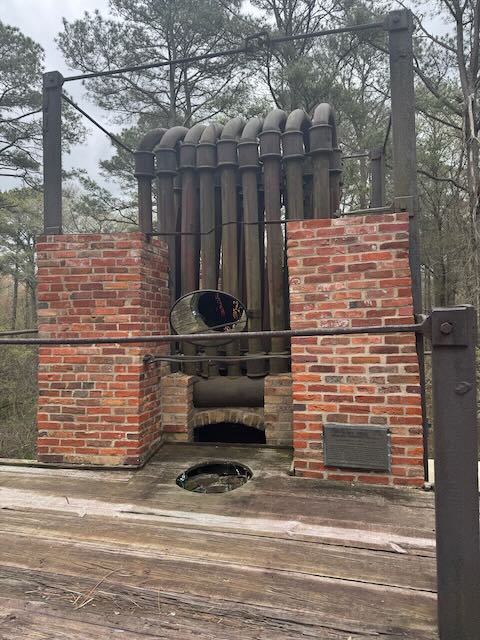
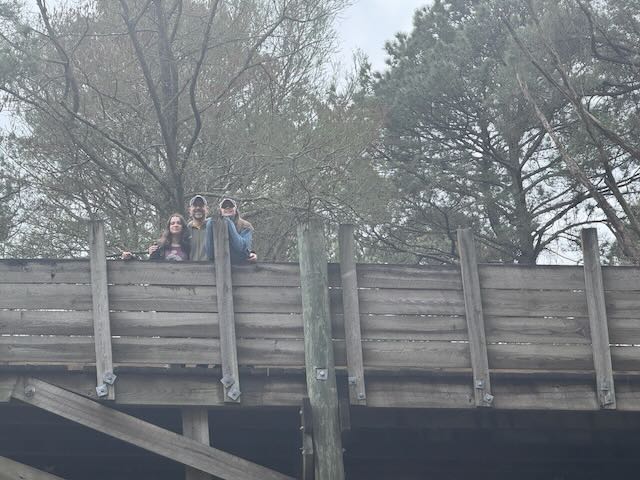
The actual Nassawango Furnace still stands (though it is not functional) at the center of the site. Visitors can walk up the charging ramp to peek down into the furnace. Blinded donkeys were used to turn a flywheel which pulled the charging carts full of bog ore taken from the nearby swamps, flux (oyster shells that helped remove impurities from the bog ore in the furnace) and charcoal up the ramp via a pulley system, to the top of the furnace. Materials were heated to about 3000 degrees and iron from the furnace was poured into molds, loaded on barges in the nearby creek and shipped off to the Pocomoke River to the Chesapeake Bay and onto Baltimore, Philadelphia and New York. (Disclaimer: This is the Spark Notes version of iron making at Furnace Town.)

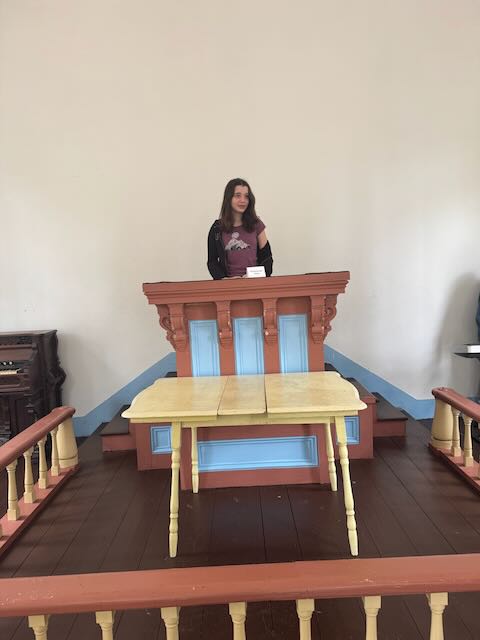
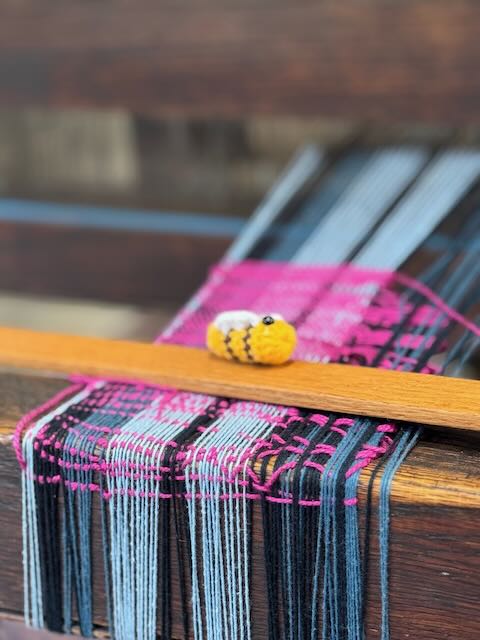
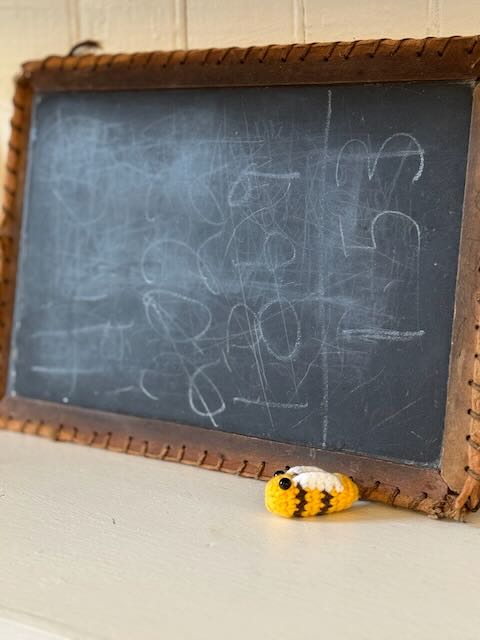
While Alyssa and Rob walked one of the loops through the woods, Kai and Jools took another path, exploring a different trail. Marlie and I decided to visit more of the buildings and caught a glimpse of the print shop, the church, the spinning house, weaving house, and the one-room schoolhouse. It’s amazing that less than 100 years ago, students were still learning in this building. School memorabilia, including desks, school supplies, books, lunch pails, and photos fill the tiny space and a huge pot-bellied cast iron stove once provided heat to students of all ages who attended. How things have changed! Can you imagine taking your lunch to school in a tin bucket or dipping your pen into an inkwell to write? There is no carpet for circle time, no whiteboard, no motivational posters… just desks in a row and a small lectern for the teacher as well as a leather strap for the occasional discipline issue. Yikes!
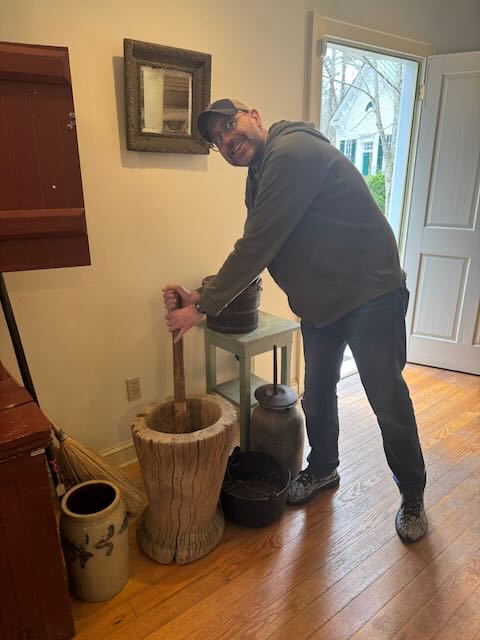


Even though we weren’t visited by the ghosts of iron-makers past, we did learn about one individual whose spirit still lives on at Furnace Town. Sampson Hat (or Harmon, depending on the storyteller) was a free African American who worked at Furnace Town in its prime. When the furnace closed, he insisted on staying in Furnace Town. Although his family moved away, Sampson stayed on for decades more, tending his garden and living in the same house, even when the town became abandoned. He refused to leave and was accompanied by his many cats. At 106 years old, Sampson moved into the town of Snow Hill (next to Furnace Town) and lived at the Alms House for one year until his death. He wished to be buried at Furnace Town, but he was denied. Some say they have seen the ghost of a tall black man walking the grounds of Furnace Town calling for Stormy, his beloved cat. To keep Sampson’s spirit alive, the staff at the historical site care for the stray cats on the property. Is the story of Sampson Hat’s ghost true? Who knows? But I loved this story and finding the statue of him in one of the museum buildings. He seems to have been a loyal, gentle and hardworking soul who loved his home and his cats. We should all be so lucky to live a life with such satisfaction.
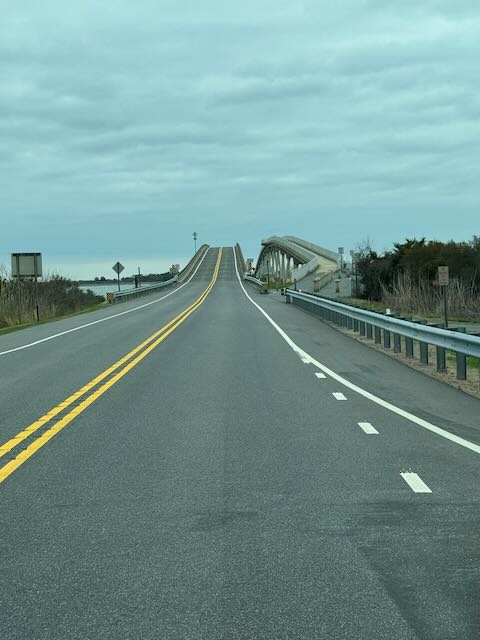
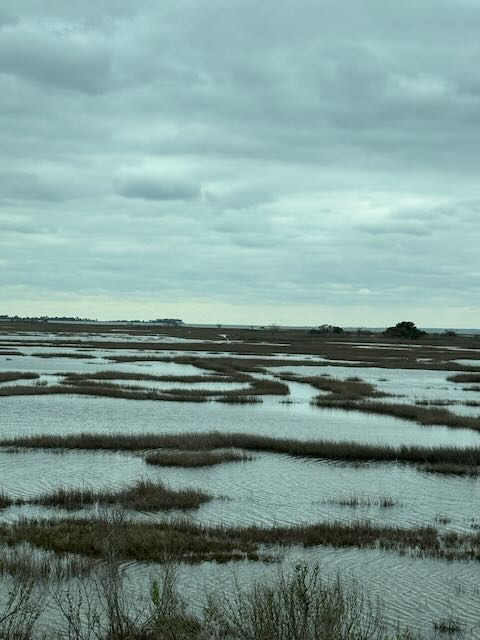
After leaving Furnace Town, we ate a quick lunch in the RV and headed through the town of Snow Hill to Berlin, Maryland, about a 30-minute ride. Crossing a rising bridge onto Assateague Island, the landscape quickly changed from farmland to marshland and ocean. Immediately, yellow horse crossing signs appeared at the sides of the road. Assateague Island has both State and National Park areas. We headed through the National Park gates, using our America the Beautiful Pass for the very first time. This pass gives us (six people and our RV) access to most National Parks for a year for the very reasonable cost of $80. Since we have plans to visit at least four National Parks this year, it just made sense to get the pass this year. Just past the gate, we got our first look at the wild horses. Of course, Rob and I were the only people not either sleeping or on our phones. Of course, we yelled, “HORSE!” when we passed the two grazing horses. (Has there ever been anyone who has not yelled this out when you pass a field of horses?) Of course, everyone else missed it.
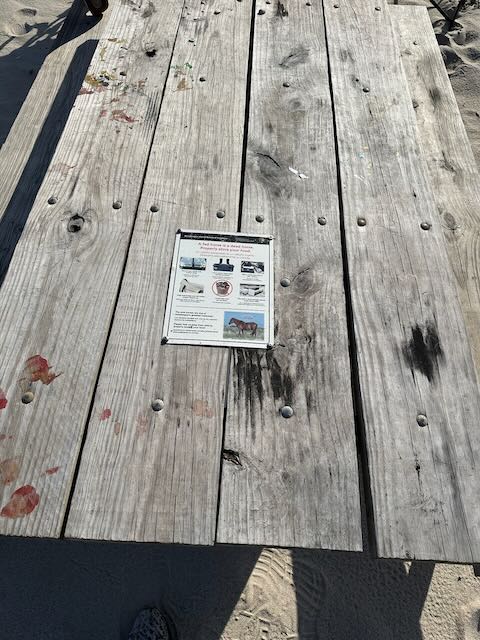
The rangers at the park take their jobs very seriously. At every turn, there are signs and warnings about interacting with and protecting the horses. As we checked in, the ranger reviewed the rules: stay at least 40 feet away from the horses, don’t feed the horses, don’t touch the horses, lock up your food if you are leaving it outside the camper. The picnic tables at each site have an enclosed compartment underneath with a metal door on one end so you can store coolers inside, away from campsite visitors. If rangers find an unattended cooler at your campsite, they will take it and leave a sign telling you to pick up your cooler at their station. “A fed horse is a dead horse.” is a very popular sign here at Assateague. Apparently, the horses know just how to get inside unlocked coolers and help themselves to human food. Just like with our New England black bears, the more the horses become accustomed to getting fed by people, the less capable they become in finding their own food, not to mention that human food is not part of the natural diet of horses. We will be keeping all our food inside the RV, so no worries about horse intruders on our campsite!


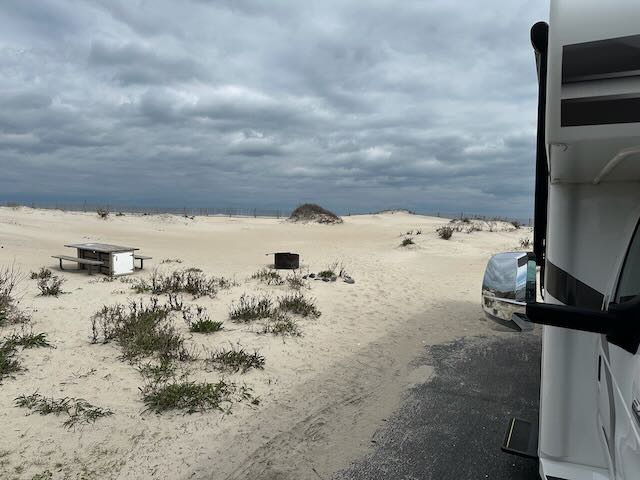
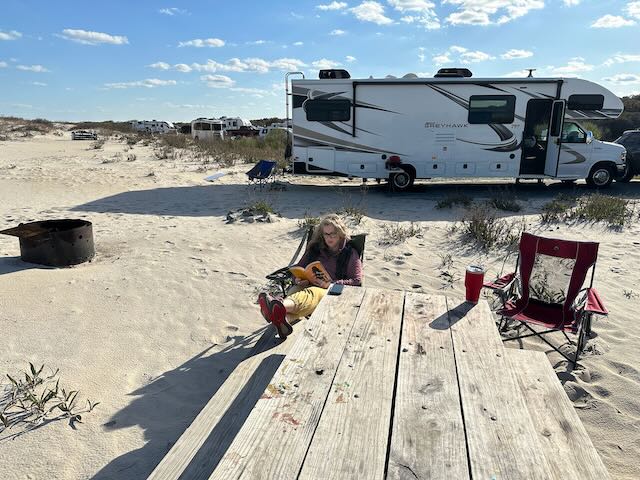
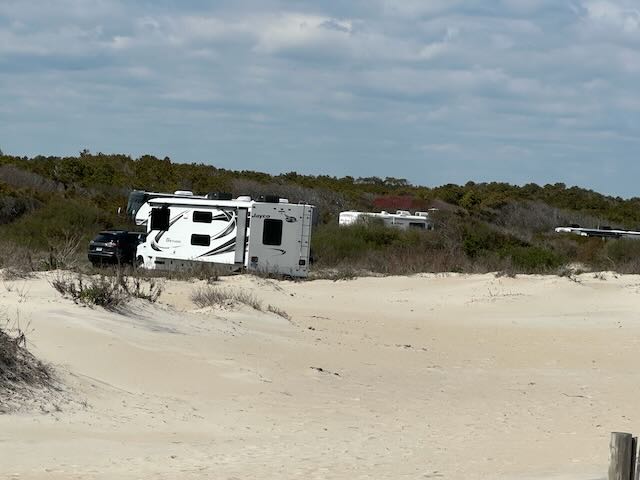
Our campsite is situated just over a low sand dune. We can see the ocean from the camper and can access it by walking two campsites over and taking the wooden footpath down to the beach. There are no hookups at this campground, meaning that we are not attached to any water or electricity. Kevin is well equipped for a couple of days of dry camping. We can run our generator from 6 AM until 10 PM (we don’t run it continuously), enough to keep it charged overnight. We emptied all our tanks and filled up the potable water tank before parking, so with conservative use of water, we will have no issue bathing, flushing, or washing up before we leave Assateague on Tuesday. Short showers for everyone, but the water is hot and we don’t need to use the pit toilets at the campground. I’ve said it before, we make no apologies for having these luxuries in the RV. When you see the campers in tents shuffling to a dark, cold pit toilet in the pitch black, you say a quiet appreciation for a generator and indoor plumbing.
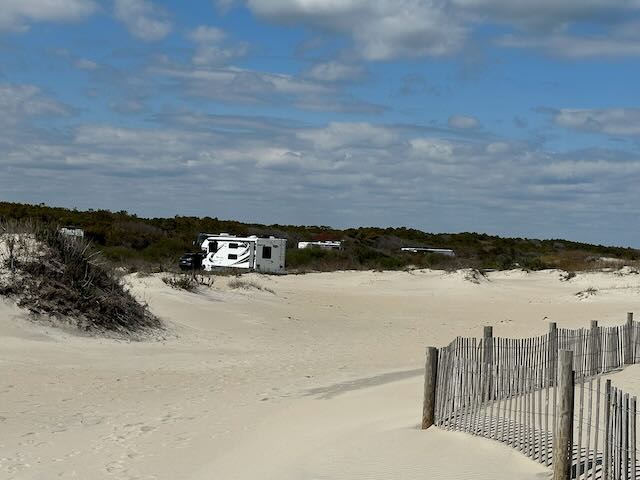
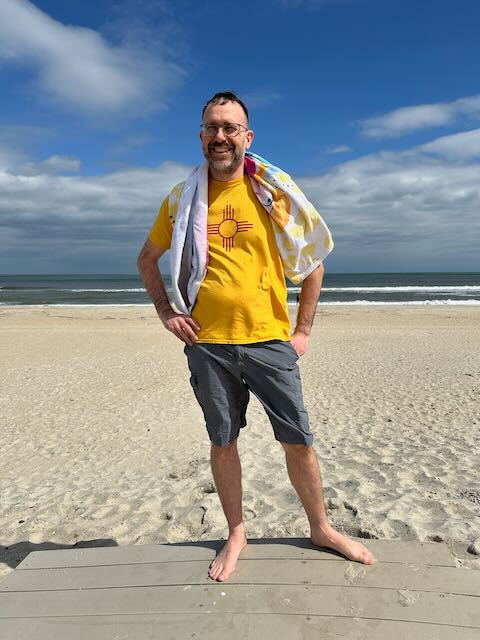
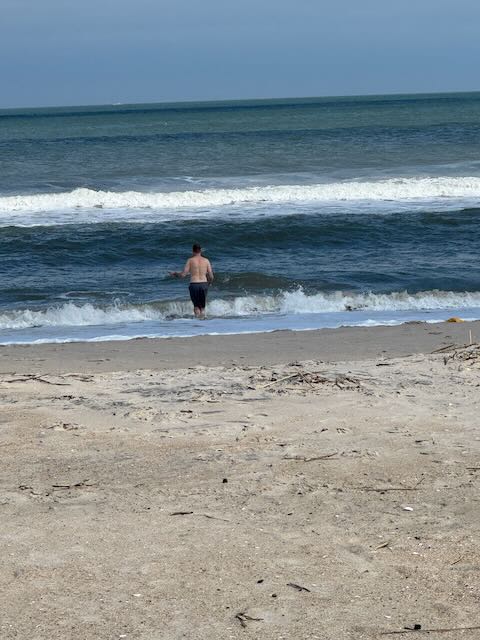
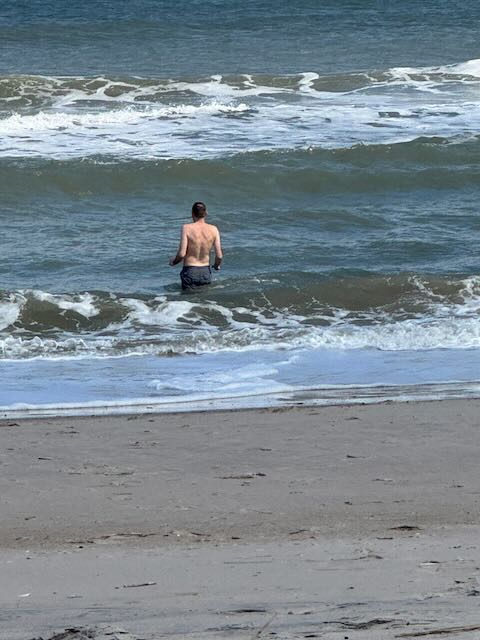
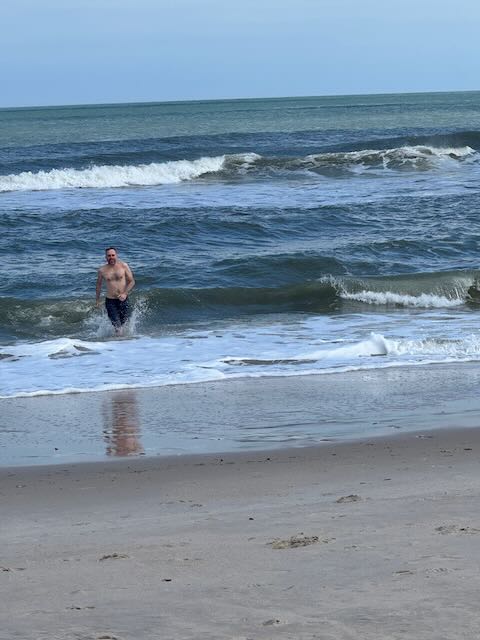
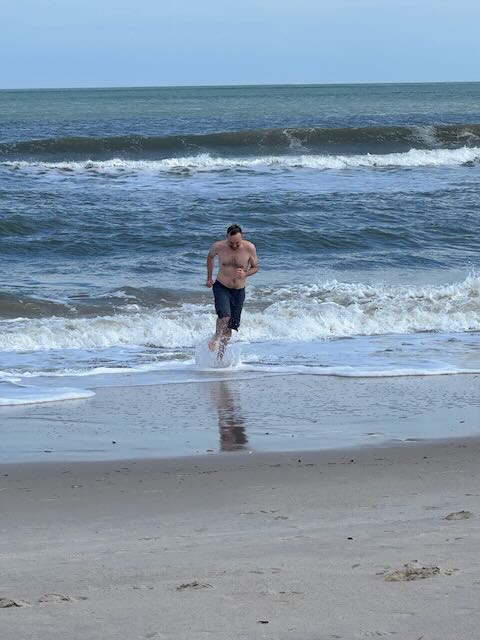
Rob had talked about a “polar plunge” into the ocean for a week leading up to our vacation. Naturally, he did not bring a bathing suit or flip flops and he was discouraged that he couldn’t simply scale the dune to run down to the water from our campsite. Well, we couldn’t let this dream die, so we hunted up a spare pair of shorts, brought a towel down to the water and made this wish a reality. With only a couple of minor hesitations, Rob successfully took his “polar plunge” in 46 degree water on a 55 degree day on Assateague Island. No wild horses were harmed in the realization of this dream.
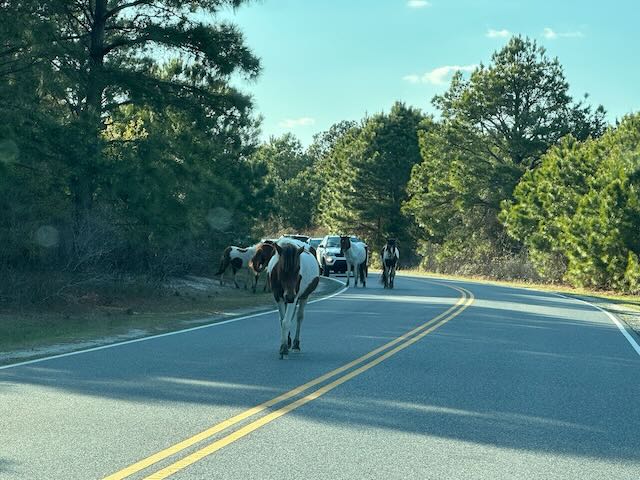
We spent the afternoon doing some exploring, relaxing, and eating. Rob, Marlie, and I took off on foot toward the Life of the Forest Trail, one of the four marked loops that weave through the island. While we didn’t see any horses on our walk, there is evidence everywhere… big piles of evidence. The horses are everywhere, even in unlikely spots like marshes and in the middle of the forest. The three of us ventured out again, this time in the Jeep, making a lap around the island at a top speed of 12 miles per hour. And just like that, we saw dozens of horses!
You can always tell where there is horse action by the line of cars pulled over at the side of the road. Little bands of horses walk on the sides of the roads, run out of the woods, play, fight and get frisky. Drivers have to be defensive. A horse might charge right at your car or two playful horses dart out in front of your vehicle. We parked to watch the horse activity and rolled down the windows to take pictures. As the horses approached the car, I rolled that window right back up. Imagine being on safari, but the only animals are horses and those animals are biters and completely unafraid of humans. I don’t feel I deserved the mocking I received from Rob. No one wants to be the example on the National Park website – woman bitten by horse in her car. Keep. Forty. Feet. Away.


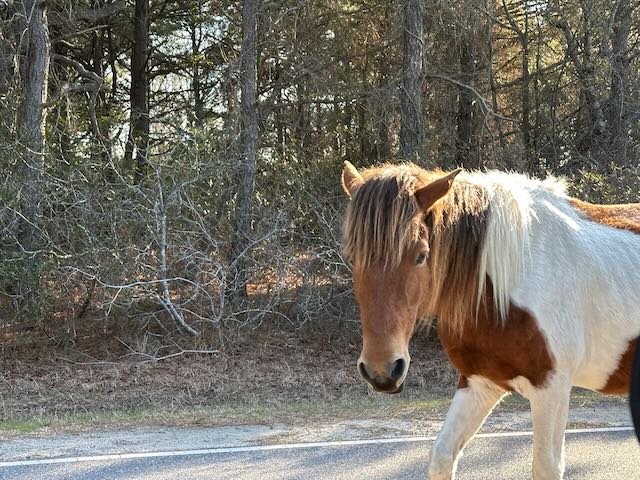
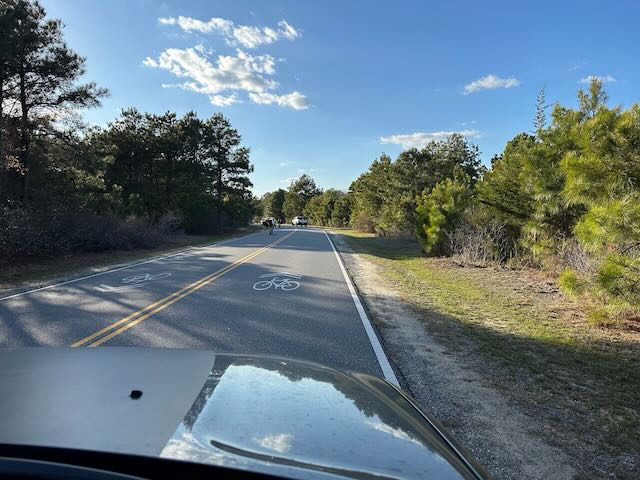
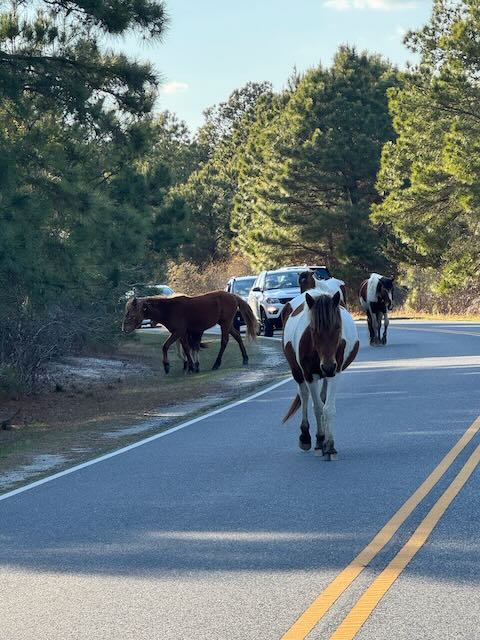



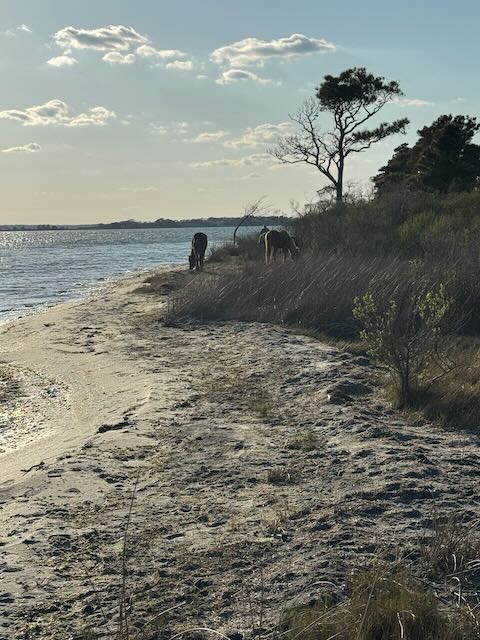
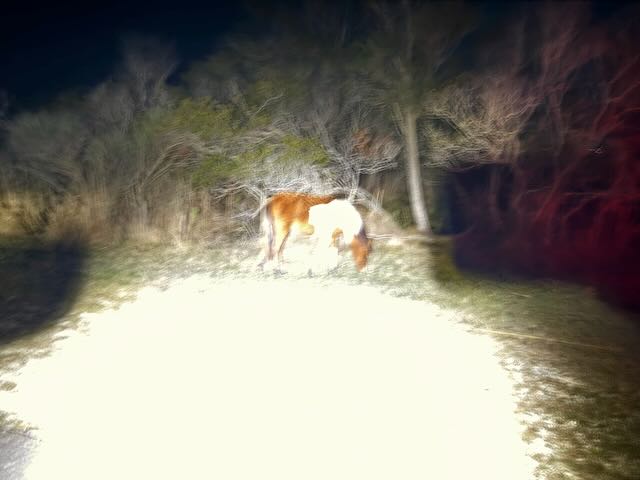


Assateague is such a unique National Park. While there is beauty in the sandy dunes and beaches along that National Seashore, the horses are the real attraction. Make no mistake, these are feral animals. The horses that live here today are likely descendents from horses brought to the island from the mainland in the 17th century. Over time, the animals have reverted to a wild state and have learned to adapt to the harsh conditions on the island – poor food quality, mosquitos, scorching heat, and violent storms. They also demonstrate unique behaviors that have evolved over hundreds of years. Popular lore tells the tale of a shipwreck that stranded the horses on the island, but there is no evidence to support this story (But isn’t that a much more romantic tale? I really wish this was true!). Assateague’s sister park, Chincoteague, is on the Virginia side of the island, separated by a fence. Ladies, if you are of a similar generation as me, you may remember the popular book, Misty of Chincoteague – a good read.
Ocean City, MD is just a quick ride from Assateague. These two vacation destinations could not be more different. We went from the quiet beauty of the beaches of the National Seashore to the glaring neon lights of Ocean City in mere minutes. One of our favorite things to do on our family trips is to do an Escape Room. Everyone has different interests and different ideas of what a good vacation is, but we can all agree that we like Escape Rooms. We aren’t all great at solving the riddles, but we have refined the art of working together and we are all incredibly competitive. We ended up at Captive Escape Rooms and chose the “Thirteen Doors” scenario (an 8.5/10 difficult rating). This escape room used some of my personal information (I registered us for the activity.) integrated into the clues, which I thought was a pretty cool feature. We had to open 13 doors to get the clues to lead us to an inheritance. We learned that all of us are pretty good at starting to solve the clues, and that Alyssa is our finisher. In the end, we solved all the clues well under the 60-minute time limit and decided to treat ourselves to ice cream. Dairy Queen for the win!

Tomorrow will be a day of exploring more trails, looking for more wild horses, visiting the camp store, and just relaxing with a good book in my camp chair! Kai wants to try out his camping grill, so he and Jools will try cooking themselves a steak and potato meal on the beach. They also want to build a fire in the fire ring and will probably take off down the beach with a frisbee. Marlie has requested game night tomorrow, and that is always a hit with everyone (after we coerce and bribe the reluctant ones into joining in). Looking forward to another fun day on the island!
 Wandering, But Not Lost